
Ask the real economy.
Understand how merchants buy, sell and keep their businesses moving. Explore evidence from Lagos markets—and investigate what your next decision needs.
309 merchants · Yaba, Sabo & Tejuosho · Observations through 10 November 2026
Source & market coverage
Validated snapshot. Checking source connection…
Observations: 7 October 2026 – 10 November 2026Analysed: 23 Nov 2026, 21:08 WAT
Yaba · Sabo · Tejuosho · Lagos
What merchants told us. What it could mean for you.
Understand everyday market decisions—and where a closer look could help your next move.

reported spending more on restocking
7 October 2026 – 10 November 2026 · Responses from businesses we visited.
About these responses
204 of 279 respondents who restock reported spending more than about three months earlier.
279 usable responses out of 309 initial observations. 30 answers were missing, unclear, inconsistent or not applicable.
Spending can rise because prices, quantities or the products purchased have changed. We have not separated those factors yet.
Before changing your replenishment offer, understand what is behind the spending.
Your next useful question: How prices, order sizes and product choices shape the next stock purchase.
Tell us your question. We’ll agree a scope, price and timeline before work begins.
309 distinct merchants in Yaba, Sabo and Tejuosho, Lagos; 41 completed return interviews across 23 linked businesses.
About this evidence & source
Field visits: 7 October 2026 – 10 November 2026. These findings describe the businesses we visited, not every business in Lagos. Each figure uses the responses available for that question.
This page shows our latest published field note.
ERI. Yaba · Sabo · Tejuosho, Lagos: restocking and ordering field note. Observations 7 October 2026 – 10 November 2026. 309 initial observations; 27 previously flagged identities owner-confirmed. analysis-v5. Analysed 2026-11-23T20:08:08.580Z. Archived aggregate edition: /briefs/yaba-cumulative-2026-11-23. Non-representative; counts refer to observations. No cross-signal overlap or measured longitudinal change is established.
What changed in the evidence?
309 original initial entries are included under the owner’s counting policy. Canonical cleanup reviews stay in a separate private backup. All response counts were rebuilt. Separately, 41 completed return interviews link to 23 businesses; latest-visit comparisons use 21 businesses before question-level exclusions. Two businesses with conflicting return evidence are held. Initial visits run through 10 November and return interviews through 20 November. This counting-policy revision is not measured economic change.
Both forms now contribute to 301 field-confirmed distinct merchants dated 7 October–9 November, plus one established revisit. All signal denominators were recalculated from the current records. The net change of 71 merchants since the 29 October edition is not a measured economic change.
Both forms now contribute to 207 field-confirmed distinct merchants dated 7–28 October, plus one established revisit. All signal denominators were recalculated from the current records. The net change of twelve merchants is not a verified count of additions or a measured economic change.
Both forms now contribute to 195 field-confirmed distinct merchants dated 7–27 October, plus one established revisit. All signal denominators were recalculated from the current records. The net change of six merchants is not a verified count of additions or a measured economic change.
Both forms now contribute to 189 field-confirmed distinct merchants dated 7–23 October, plus one established revisit. All signal denominators were recalculated. New merchant submissions add to this cumulative total; revisits track existing merchants.
The owner confirmed the 27 previously flagged identities. Their checks are complete. The v2.0 answers and all six signal counts are unchanged; this is an identity-status correction, not economic change.
All 28 previously held-out rows joined the cohort: 27 observations were flagged at that time (resolved by owner confirmation on 26 October); one shifted row was recovered from its source answers. The 87 → 115 revision is not economic growth or a measured trend.
Identity-review flags prompted an earlier 87-observation cohort. The subsequent owner-approved policy included these observations; their 27 identity flags were resolved on 26 October.
Collection, source repairs and inclusion rules are different from changes in the same businesses. See the separately matched return-visit findings and their limits ↗
What would you like to understand?
Explore payments, recordkeeping, trading conditions, restocking, credit and remote orders. Start with a finding, then decide what you need to know next.
Have a decision beyond these topics?
Typing a question does not save it. It is stored only if you explicitly submit an enquiry.
309 distinct merchants in Yaba, Sabo and Tejuosho, Lagos; 41 completed return interviews across 23 linked businesses. These findings describe the businesses we visited, not every business in Lagos. Each figure uses the responses available for that question.
Read beyond
the headline.
What the evidence may mean for your next decision. Short analyses of market practices, pressures and questions worth investigating.
Before designing stock finance, find out how merchants already pay for stock
Trace a recent stock purchase with merchants who paid upfront, used supplier terms or borrowed cash. Compare when payment was due, when the goods were likely to sell and what the merchant did when cash was tight.
Read the analysis ↗Test what a sales record helps a merchant do before building a ledger
Ask merchants to show how they answered a recent question that mattered: what sold, what a customer owed, or what needed restocking. If the same question repeatedly takes too long to answer, test a short record designed around that decision for one trading week.
Read the analysis ↗Better trading is a reason to test a location before signing a lease.
Merchants recall better trading conditions. A short selling trial can test whether a new outlet would benefit.
Read the analysis ↗If transfers are already the norm, what happens after the customer pays?
Before building another payment acceptance tool, find out whether merchants need help matching transfers to sales.
Read the analysis ↗A rising restocking bill is a reason to inspect the basket—not assume inflation.

Higher expenditure is common among usable responses. Procurement and finance teams need to separate prices, quantities and product mix before choosing a response.
Read the analysis ↗The ordering opportunity may sit between the message and the delivery.

Remote orders are already part of trading for many merchants visited. For distribution teams, the more useful opportunity may be understanding fulfilment before introducing another ordering channel.
Read the analysis ↗Walk the stalls. Test what you think you know.
Six hands-on ways into the same merchant visits. Guess before you look, see where a business like yours stands, or take a buyer’s decision through the evidence.
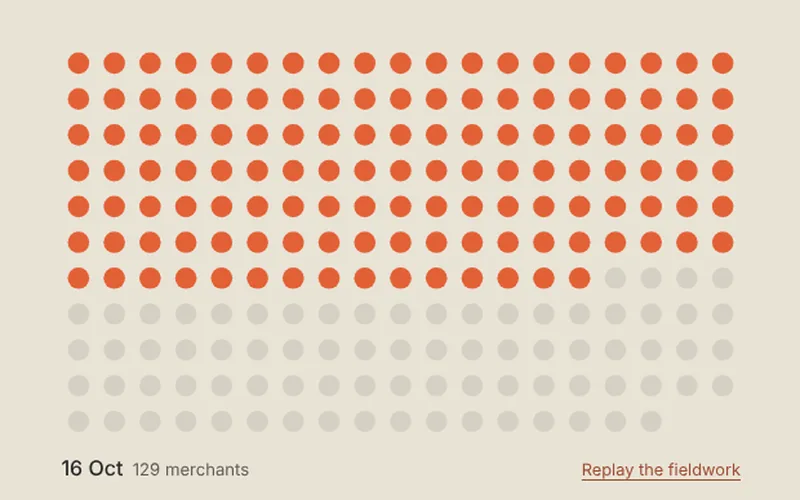 EveryoneStall by StallWatch the picture settle day by day, follow transfer-first merchants into remote orders, and see how a stall visit becomes evidence.
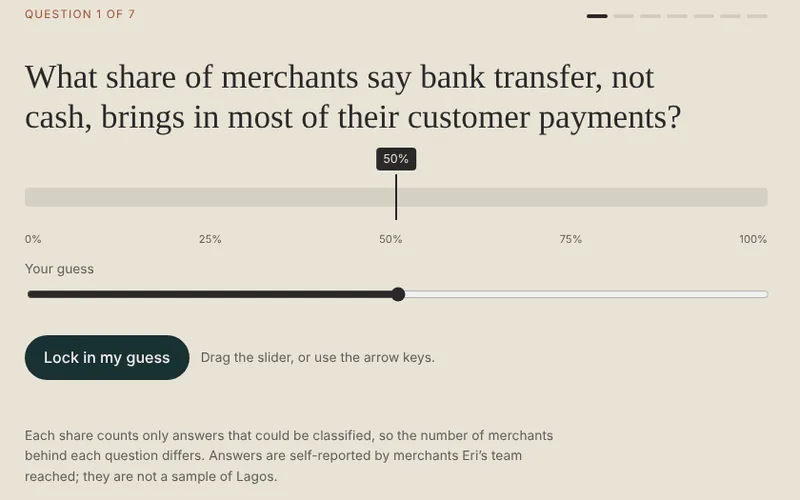 New readersGuess FirstGuess how merchants answered, then see what they told the field team.
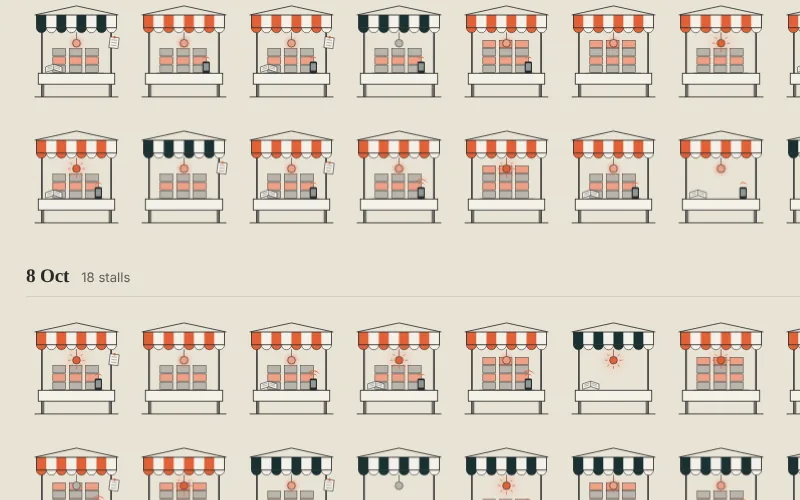 Culture and editorialStall PortraitsA lane of composite stalls drawn from the published answers. Arrange it by any question.
 MerchantsWhere Do I Stand?Answer six questions in English or Pidgin and see how you compare. Nothing is saved.
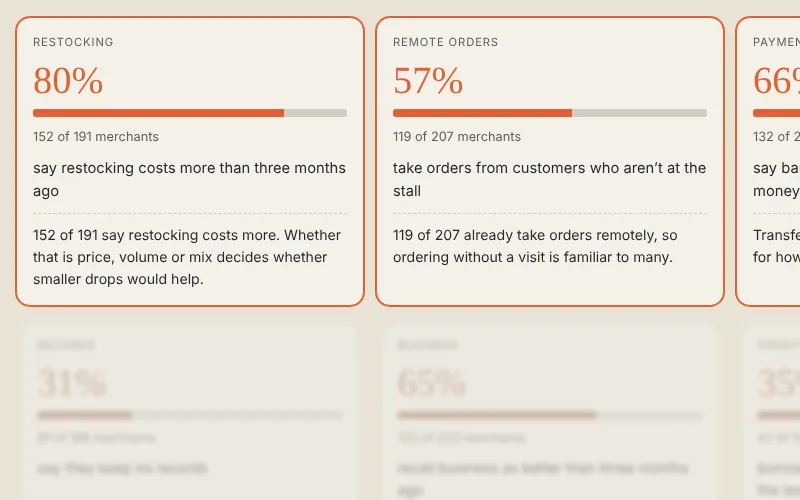 BuyersDecision LensPick your role and decision. See what the evidence says, what it can’t, and the field question that would settle it.
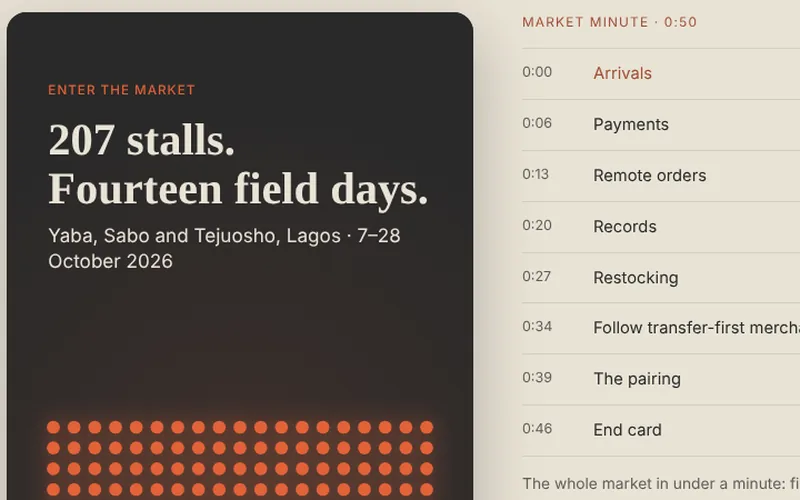 DistributionMarket MinuteA 50-second vertical film and a postable card for each finding.
What changed when we returned?
41 completed return interviews link to 23 businesses. The latest comparison uses 21 businesses, with a separate usable-response count for each question.
Return interviews: 29 Oct 2026–20 Nov 2026. Repeated visits stay separate from the initial merchant total.
Explore return-visit findings and matching ↗
One useful finding,
when there is one.
A short summary written for your role when a new edition is published. Confirm your email, and unsubscribe at any time.
Where the evidence comes from, how every answer is checked, and what it can’t tell you.
How ERI knows: coverage, checks & method ↗